
Choosing the right A Level exam board is an important part of preparing for further education. Students often hear names such as OCR, AQA, Edexcel, and Cambridge but may not fully understand how these organisations differ. Although they offer qualifications at a similar academic level, their subject specifications, assessment structures, and examination approaches can vary. Understanding these differences helps students plan their studies, select appropriate revision resources, and prepare confidently for examinations.
Schools usually choose the examination board for each subject, but private candidates and families considering different educational pathways may have more options. Among the available qualifications, OCR A Level is a common choice in England, offering subjects across science, mathematics, humanities, and creative disciplines. Other A-level exam boards provide different specifications and assessment arrangements. This guide explains their main features, compares their approaches, and helps students understand what matters when preparing for A Level examinations.
What Are A Level Exam Boards?
A Level exam boards develop qualifications, prepare examination papers, assess student performance, and award grades. They publish subject specifications explaining what students must learn and how their knowledge will be assessed. In England, awarding organisations follow regulatory requirements that help maintain qualification standards. However, different boards may organise subject content, examination questions, and assessment components differently. International qualifications can follow separate structures and regulations.
For example, a student studying OCR A Level Biology may cover many of the same fundamental scientific concepts as someone studying Biology with another board. However, the order of topics, practical requirements, question formats, and specification details may differ. Students should therefore follow resources designed for their exact qualification.
OCR A Level Subjects, Structure and Assessment
OCR stands for Oxford, Cambridge and RSA Examinations. It is an established awarding organisation in England that provides academic and vocational qualifications, including A Levels across numerous subjects. The board offers qualifications in Biology, Chemistry, Physics, Mathematics, Computer Science, Psychology, History, and other disciplines. Some subjects have multiple specifications, allowing schools to select an approach that suits their teaching plans. For example, OCR offers different routes for certain science and mathematics qualifications.
What Makes OCR A Level Different?
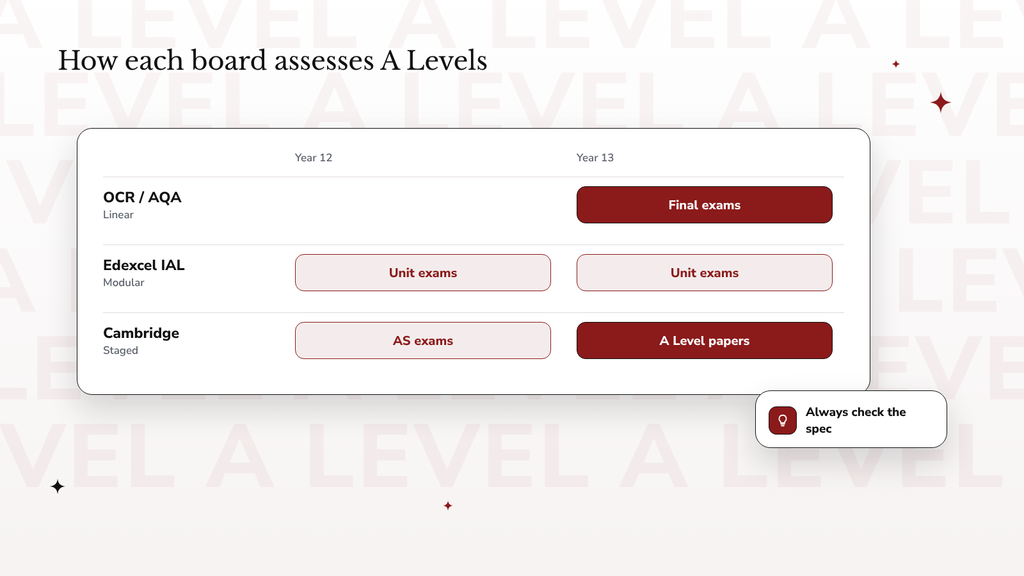
One notable feature is the availability of alternative specifications in selected subjects. For instance, OCR offers Biology A and Biology B, which organise learning and assessment differently while covering relevant academic knowledge and skills. Students following OCR A Level courses generally complete linear assessments, meaning their final written examinations take place at the end of the qualification.
Some subjects also include practical activities or non-examination assessments, depending on their official specifications. OCR publishes specifications, past papers, mark schemes, examiner reports, and other resources. These materials help students understand how questions are structured and what examiners expect in successful answers.
AQA Subjects and Examination Approach
AQA is another major awarding organisation in England. It provides A Level qualifications covering subjects such as English Literature, Mathematics, Psychology, Biology, Chemistry, and History. An AQA A-level course follows an official subject specification that identifies the required content, assessment objectives, and examination components. Depending on the subject, students may need to demonstrate factual knowledge, interpretation, evaluation, mathematical skills, or extended written reasoning.
For example, a Psychology student may need to explain research methods and evaluate psychological theories. Meanwhile, an English Literature student may be expected to analyse texts and develop arguments supported by evidence. Students comparing AQA with other exam boards should review the official subject specifications rather than assuming one board is easier. The key differences often include syllabus content, question formats, mark allocation, and assessment requirements.
Edexcel A Level and International Qualifications
Pearson Edexcel offers qualifications used in England and internationally. Its subject range includes mathematics, sciences, business, economics, and humanities. An Edexcel A-level qualification regulated in England generally follows a linear structure, with final examinations taken at the end of the course. Pearson also offers International A Levels, commonly called IALs, which have different assessment arrangements.
One important distinction is that many Pearson Edexcel International A Levels use a modular structure. This allows students to complete individual examination units across available sessions, subject to the qualification rules. By comparison, OCR A Level qualifications in England are linear. Students preparing for these different systems should understand examination timing, resit arrangements, and how individual assessments contribute to their final grades.
Cambridge International A Level as a Global Qualification
Cambridge International Education provides qualifications designed for learners in different countries. Its International AS and A Level programmes support students preparing for university and further academic study. A Cambridge International A-level course typically takes two years, although students may complete an International AS Level after approximately one year. The qualification offers assessment routes that differ from the linear structure commonly used in England.
Assessment Options for International Students
Cambridge International offers several assessment pathways. Students may take AS Level as a standalone qualification, complete AS and A Level assessments in stages where permitted, or take all required A Level papers in one examination series. Under the staged route, eligible AS results may be carried forward within the permitted period.
Not every subject supports this option, so students must check the relevant syllabus before planning their examination entries. Students comparing Cambridge qualifications with OCR A Level should consider where they intend to study, which examination centres are available, and whether their preferred universities accept the specific qualification.
Key Differences Between OCR A Level vs AQA, Edexcel and Cambridge
Although these examination systems assess advanced academic knowledge, their structures differ. Understanding the distinctions helps students identify appropriate study resources and prepare for the correct examinations.
| Exam board | Main qualification focus | Assessment structure |
| OCR | England | Linear A Levels; subject-specific non-exam assessment where required |
| AQA | England | Linear A Levels; assessment varies by subject |
| Pearson Edexcel | England and international markets | Linear UK A Levels; modular International A Levels |
| Cambridge International | International students | Full assessment in one series or staged routes where available |
The table provides a general comparison. Individual subject specifications determine the actual examination components, coursework requirements, and assessment methods. A student studying Mathematics, for example, should not assume that questions from another exam board’s papers follow the same syllabus or examination style. Practising different types of questions can improve mathematical understanding, but using past papers from the relevant exam board remains essential for effective preparation.
Do Exam Boards Have Different Difficulty Levels?
Students frequently ask whether one board is easier than another. There is no reliable universal ranking because difficulty depends on the subject, specification, examination paper, and individual learner. In England, regulated A Levels are designed to maintain comparable qualification standards. Grade boundaries may differ between examination series and boards to reflect variations in paper difficulty.
Rather than selecting OCR A Level or another qualification based on an assumed advantage, students should consider their preferred subjects, learning strengths, available teaching support, and the exact assessment requirements.
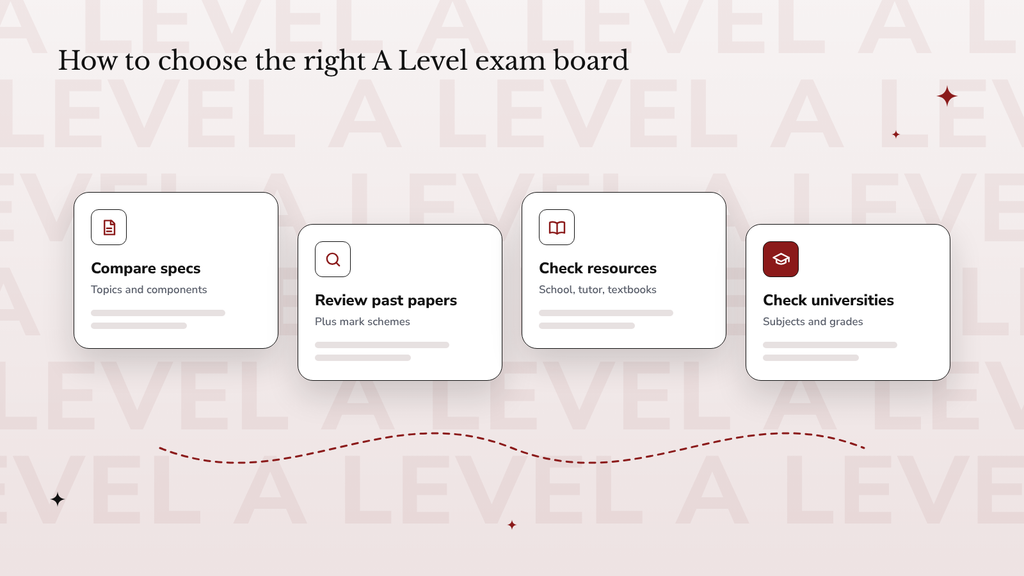
How to Choose the Right A Level Exam Board
Choosing an examination board requires more than comparing names. Students should focus on the qualification’s subject content, assessment style, and compatibility with their educational plans.
1. Compare Subject Specifications
Begin by downloading the current specification from the awarding organisation’s official website. Review the required topics, assessment objectives, examination components, and any practical or coursework expectations. For example, students considering Chemistry should check which specification their school offers. Different specifications within the same exam board can have distinct teaching approaches and assessment details.
2. Review Past Papers and Mark Schemes
Past examination papers provide useful insight into how questions are presented. They also help students identify whether assessments require calculations, essays, source analysis, explanations, or practical applications. Read the accompanying mark schemes and examiner reports to understand how answers are evaluated. This approach is more useful than relying on general claims about which board is easier.
3. Consider Teaching and Learning Resources
Access to suitable resources can significantly influence examination preparation. Students should check whether their school, tutor, textbooks, and revision platforms support their chosen specification. A learner studying OCR A Level Physics, for instance, should prioritise resources aligned with the relevant OCR syllabus. Materials from other boards may provide additional practice, but they should not replace specification-specific revision.
4. Check University and Examination Requirements
Students planning university applications should review entry requirements for their intended courses. Most importantly, they should confirm required subjects, grades, and the recognition of their specific qualification.
International students should also verify examination-centre availability and entry arrangements before selecting a qualification. This is particularly important when studying independently or applying to universities in another country.
Practical Study Tips for A Level Students
Successful examination preparation begins with understanding the specification. Students should divide their subjects into manageable topics, identify areas requiring additional practice, and develop a realistic revision schedule. For OCR A Level students, reviewing past papers alongside official mark schemes can help identify common mistakes and improve examination technique. However, understanding why an answer is correct remains more valuable than memorising marking phrases without context.
Students can also use active recall, spaced revision, timed questions, and self-assessment. For example, a Biology learner might revise cell structure, explain the topic without notes, and then attempt relevant examination questions. Keeping a record of mistakes helps identify recurring weaknesses. Whether studying with OCR, AQA, Edexcel, or Cambridge, regular practice and thoughtful feedback are essential parts of effective preparation.
Common Mistakes When Preparing for A Level Exams
One frequent mistake is using revision materials intended for the wrong examination board. Although subjects overlap, specifications may differ in content, terminology, and assessment expectations. Another mistake is concentrating entirely on memorisation. Many A Level questions require students to apply knowledge, explain relationships, interpret information, or evaluate evidence rather than reproduce memorised facts.
Students should also avoid leaving examination practice until the final weeks. Introducing past-paper questions throughout the course can strengthen understanding and help learners become familiar with expected answer structures.
Conclusion
Understanding A Level exam boards helps students make informed decisions about qualifications, learning materials, and examination preparation. OCR, AQA, Edexcel, and Cambridge offer established academic pathways, but their assessment structures and subject specifications can differ. OCR A Level provides a broad selection of subjects within England’s regulated qualification system, while other boards offer different specifications or international assessment routes. The best approach is to examine the exact syllabus, understand the assessment requirements, and choose resources that support the student’s academic goals.
Frequently Asked Questions
1. What is OCR A Level, and how does it work?
OCR A Level is an advanced qualification awarded by OCR in England. Students usually study over two years and complete final examinations, alongside any required non-examination assessments, according to their subject specification.
2. Is OCR harder than AQA or Edexcel?
Not necessarily. Examination difficulty varies by subject and paper. England’s regulated A Levels follow common standards, so students should focus on the specification and assessment style rather than assuming one board is easier.
3. Can students switch between A Level exam boards?
Switching may be possible, particularly early in a course, but differences in content and assessment can create difficulties. Students should consult their school or examination centre before making changes.
4. Are Cambridge International A Levels accepted by universities?
Cambridge International A Levels are recognised by universities worldwide. However, applicants should always check the subject, grade, and qualification requirements of their chosen institution.
5. Which exam board is best for independent students?
The most suitable board depends on examination-centre access, subject availability, assessment requirements, and learning resources. Private candidates should also check whether their chosen subject includes practical or non-exam assessment components.