
GCSE examinations are an important stage in secondary education, helping students demonstrate their knowledge before progressing to A Levels, vocational qualifications, or further training. However, many parents and students find the examination system confusing, particularly when schools mention different boards such as AQA, OCR, and Edexcel. Although these organisations provide qualifications at the same academic level, their subject specifications, assessment structures, and examination questions may differ.
Understanding these differences can help families select suitable revision resources, prepare effectively, and avoid confusion about examination requirements. Among the major awarding organisations, OCR GCSE offers qualifications across science, mathematics, humanities, and creative subjects. AQA and Edexcel also provide a wide range of GCSE courses, each following regulatory requirements in England. This guide explains how the three boards work, compares their differences, and provides practical advice for students and parents.
What Are GCSE Exam Boards?
GCSE exam boards are awarding organisations responsible for developing qualifications, preparing examination papers, marking assessments, and awarding final grades. They publish official specifications that explain what students must study and how their knowledge will be assessed.
In England, exam boards operate under regulations established by Ofqual, the qualifications regulator. These requirements help maintain comparable standards across awarding organisations, although individual specifications may organise topics and assessments differently.
For example, a student studying Biology may cover many of the same scientific concepts as students following other examination boards. However, the order of topics, question formats, and specific assessment requirements may vary. This makes it important to use learning materials designed for the correct examination board.
How to Find Your Child’s Exam Board
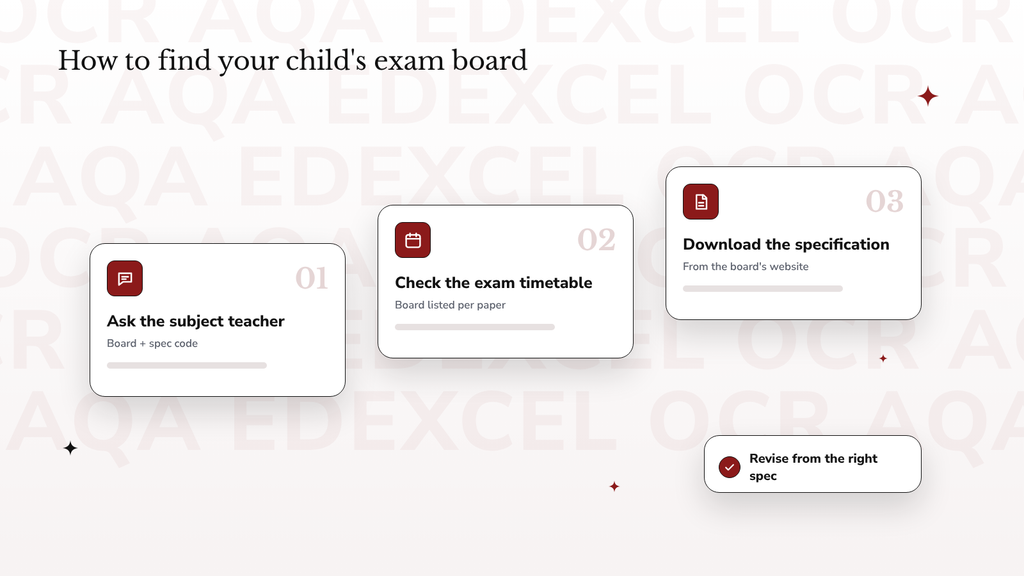
Understanding how to find your child’s exam board is important when selecting revision guides, arranging tutoring, or preparing for examinations. Parents can check school websites, examination timetables, or course documents to identify the relevant awarding organisation. They can also contact subject teachers to confirm the exact exam board and specification code, ensuring their child uses appropriate study materials.
OCR GCSE Subjects, Structure and Assessment Guide
OCR stands for Oxford, Cambridge and RSA Examinations. It is an awarding organisation that provides GCSEs, A Levels, and vocational qualifications in England. Its GCSE subject range includes Mathematics, English, Biology, Chemistry, Physics, Computer Science, History, and Geography. One important feature is the availability of different specifications for certain subjects.
For example, OCR offers Gateway Science and Twenty First Century Science routes. These provide different approaches to organising and assessing scientific knowledge. Students following OCR GCSE courses typically complete final written examinations, although subjects such as Art and Design, Drama, or Physical Education may include non-examination assessments. The exact requirements depend on the qualification specification.
What Makes OCR GCSE Different?
A notable feature is the choice of alternative specifications in selected subjects. Schools can compare different approaches and choose one that supports their teaching plans and students’ learning needs. For example, OCR offers different Geography and History specifications, allowing schools to select particular topics or approaches to studying the subject.
Students should check their school’s exact qualification before purchasing revision materials. The board also provides past examination papers, marking guidance, examiner reports, and other teaching resources. These materials help learners understand how examination questions are structured and what is expected in successful answers.
Understanding AQA GCSE Qualifications
AQA is one of England’s established examination boards, offering GCSE qualifications across a broad selection of academic and creative subjects. Its courses include Mathematics, English Language, English Literature, Biology, Chemistry, Physics, Business, and Psychology. Each AQA qualification follows an official specification outlining the required subject knowledge and assessment objectives. These objectives describe the skills students must demonstrate, such as recalling information, applying knowledge, analysing evidence, or evaluating arguments.
When comparing AQA with OCR GCSE, students should review the specifications rather than assume that one board offers simpler examinations. Differences can include prescribed content, topic organisation, question wording, and non-examination assessment requirements. For example, a History student may study different historical periods depending on the specification selected by their school. Even when broad themes overlap, the required examples and depth of knowledge can differ between boards.
Understanding Pearson Edexcel GCSE Qualifications
Pearson Edexcel is another awarding organisation providing GCSE qualifications in England. Its subject range includes English, Mathematics, sciences, humanities, languages, and other academic disciplines. Edexcel qualifications follow official specifications that describe what students need to learn and how their performance will be assessed. As with other boards, GCSE examinations may include written papers, practical activities, or non-examination assessments, depending on the subject.
Students comparing Edexcel with OCR GCSE should pay attention to assessment formats and subject requirements. A mathematics paper, for example, may test similar curriculum content but use different question sequences, contexts, and mark allocations. Pearson also provides International GCSE qualifications, which should not be confused with its GCSE qualifications regulated in England. Families studying internationally should check the exact qualification title and syllabus before choosing examination resources.
Key Differences Explained for AQA vs OCR vs Edexcel:
The comparison of AQA vs OCR vs Edexcel becomes clearer when students examine what each board offers and how qualifications are structured. All three provide GCSEs in England, but there may be differences in subject options, course organisation, and assessment materials.
| Feature | OCR | AQA | Pearson Edexcel |
| GCSE qualifications | Yes | Yes | Yes |
| Main region | England | England | England |
| Grading system | 9–1 | 9–1 | 9–1 |
| Subject specifications | Board-specific | Board-specific | Board-specific |
| Written examinations | Yes | Yes | Yes |
| Non-exam assessment | In relevant subjects | In relevant subjects | In relevant subjects |
| Revision resources | Specifications, past papers, mark schemes | Specifications, past papers, mark schemes | Specifications, past papers, mark schemes |
The table highlights their general similarities, but individual subject specifications provide the most meaningful differences. Students should not assume that all subjects follow identical assessment arrangements. For instance, someone studying OCR GCSE Mathematics should prioritise papers from their own specification. Questions from other boards can offer additional practice, but they may not reflect the exact structure of the final examination.
Which GCSE Exam Board Is Easiest?
A common question among students and parents is which GCSE exam board is easiest. There is no reliable universal answer because examination difficulty depends on the subject, paper, assessment requirements, and individual students’ strengths. Ofqual works to maintain comparable grading standards across GCSE awarding organisations in England.
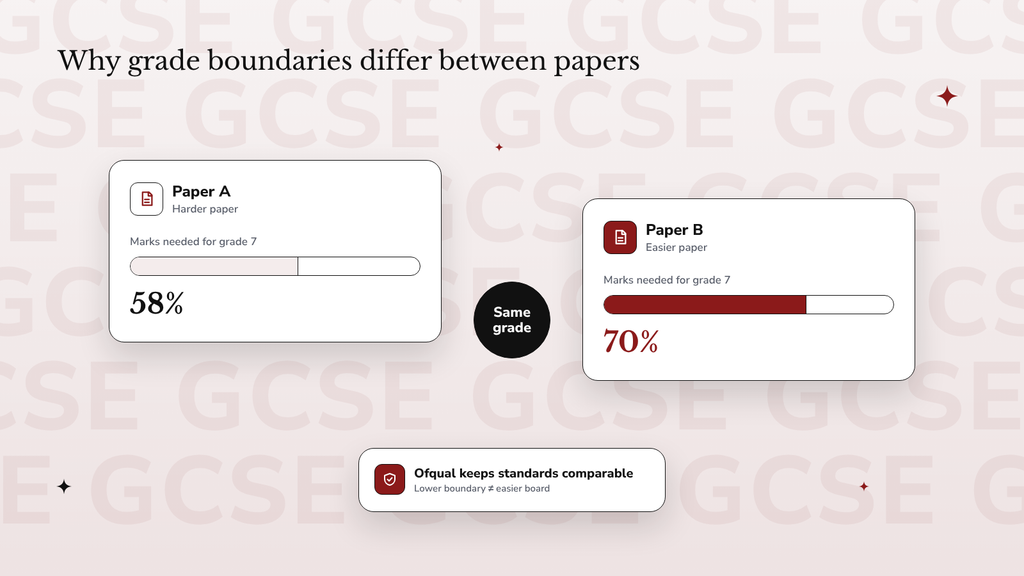
Grade boundaries can vary because examination papers differ in difficulty, but lower boundaries do not automatically mean a board is easier. For students following OCR GCSE, success depends more on understanding the specification, developing examination techniques, and practising consistently than on perceptions about board difficulty. Choosing appropriate resources and addressing weaknesses can make preparation more effective.
Why Do Grade Boundaries Differ?
A grade boundary is the minimum mark required to achieve a particular grade. These boundaries are set after examinations have been marked and evidence about paper difficulty and student performance has been reviewed. For example, if a paper proves more challenging than expected, its grade boundaries may be lower than those of a less demanding paper. This adjustment helps maintain grading standards rather than giving students an unfair advantage. Consequently, comparing the percentage of marks needed for a grade across boards is not a reliable way to identify the easiest qualification.
How to Find Your Child’s Exam Board
Parents often want to know how to find their child’s exam board, especially when buying textbooks, arranging tutoring, or helping with revision. Fortunately, schools usually provide this information through subject departments or examination staff. The easiest approach is to ask the subject teacher which awarding organisation and specification are being used. Schools may use different exam boards for different subjects, so checking each subject individually is important.
For example, a student might take OCR GCSE Computer Science while studying AQA English and Edexcel Mathematics. Parents should confirm the relevant qualification codes to ensure that revision materials match the correct course.
Check School Documents and Official Specifications
Parents can also look at examination timetables, course guides, school websites, and revision information provided by teachers. These documents may identify the examination board and specification code. Once identified, visit the board’s official website to download the relevant subject specification. This document lists required topics, assessment components, and other important examination information.
How to Choose the Right GCSE Revision Resources
Choosing revision resources designed for the correct specification is essential. Although GCSE subjects share national requirements in England, the detailed organisation of topics and examination formats may differ. Students taking OCR GCSE Science should use resources aligned with the correct science route.
Studying from an unrelated specification may introduce unnecessary topics or fail to cover important content in sufficient detail. Past papers, mark schemes, official specifications, and suitable revision textbooks provide a useful starting point. Students can also use flashcards, topic summaries, and timed practice to strengthen their understanding.
Practical Example of Preparing for GCSE Mathematics
Consider a student preparing for Mathematics who struggles with algebra and geometry. The first step is to identify the relevant specification and review the topics included in the examination. The student can then practise algebra questions, check answers against mark schemes, and record common mistakes. After improving individual skills, they can complete timed papers to develop examination confidence.
For Mathematics students, practising official past papers is particularly helpful for becoming familiar with examination question formats and structures. However, understanding mathematical concepts and problem-solving methods is more important than simply memorising answers to previous questions.
Common Mistakes Students Should Avoid
One common mistake is studying from revision guides intended for another exam board. Although the subject may be the same, different specifications can include different content, examples, and assessment expectations. Another mistake is focusing entirely on memorising facts without practising their application.
GCSE examinations often require students to explain concepts, solve problems, analyse information, or support arguments with evidence. Students preparing for OCR GCSE examinations should also avoid leaving past-paper practice until the final weeks. Regular practice throughout the course can improve understanding, highlight weaknesses, and help students become familiar with examination requirements.
How Parents Can Support GCSE Preparation
Parents can support their children by helping them create realistic study schedules and encouraging consistent revision. Short, focused study sessions combined with regular breaks can make challenging subjects more manageable. Checking the examination board and specification before purchasing textbooks or arranging tuition is equally important.
Resources should match the subjects and qualifications students are actually studying. Parents should also encourage learners to review mistakes rather than concentrate only on scores. Constructive feedback, appropriate revision materials, and steady progress can help students prepare with greater confidence.
Conclusion
Understanding the differences between GCSE examination boards helps students and parents make informed decisions about revision resources, subject requirements, and examination preparation. AQA, OCR, and Edexcel all provide regulated qualifications in England, but their specifications and assessment approaches can differ. OCR GCSE offers a broad selection of subjects and resources, while AQA and Edexcel provide alternative specifications. Rather than searching for the easiest board, students should focus on understanding their syllabus, practising relevant examination questions, and developing effective study habits.
Frequently Asked Questions
1. What is OCR GCSE, and how does it work?
OCR GCSE is a secondary education qualification awarded by OCR in England. Students follow a subject specification and complete examinations and, where required, non-examination assessments to achieve grades on the 9–1 scale.
2. Is AQA easier than OCR or Edexcel?
There is no reliable evidence that one board is consistently easier across all GCSE subjects. Assessment formats may differ, but Ofqual works to maintain comparable grading standards across boards.
3. Can a school use different GCSE exam boards?
Yes. Schools can select different awarding organisations for different subjects. For example, English, Mathematics, and Science may each follow specifications from separate boards.
4. Do universities prefer particular GCSE exam boards?
Universities generally focus on relevant GCSE subjects and achieved grades rather than favouring a particular awarding organisation. Students should check specific entry requirements for their intended courses.
5. Where can students find official GCSE past papers?
Students can find past papers, specifications, and available mark schemes on the official AQA, OCR, and Pearson Edexcel websites. Some recent examination materials may be restricted to teachers. Meta description correction: The earlier description was 158 characters. Here is a revised version within your requested limit.