
Receiving A-Level results can be an important moment for students preparing for university or future career opportunities. However, not everyone achieves the grades they expected. Some students narrowly miss university entry requirements, while others want to improve their academic performance before applying for competitive courses. Retaking examinations provides another opportunity to strengthen subject knowledge and achieve better results. Students can use additional preparation time to address weaknesses, practise examination techniques, and develop more effective study habits. Understanding the available options helps learners make informed decisions about their next steps.
An A-Level resit allows students to retake a qualification to improve their previous grade. In England, most A-Level examinations take place during the summer examination series, meaning students usually wait until the following year to retake their subjects. This guide explains the rules, examination dates, registration process, costs, university considerations, and practical ways to prepare successfully. Preparing for another examination attempt can sometimes feel challenging, especially when students are disappointed with their previous results.
What Is an A-Level Resit and How Does It Work?
An A-Level resit is an opportunity to retake an Advanced Level qualification after receiving an earlier examination result. Students commonly consider this option when they have not achieved the grades required for university admission, apprenticeships, or particular professional pathways. In England, A-Levels are generally linear qualifications, meaning students complete the relevant final examinations at the end of the course. When retaking a qualification, candidates usually need to sit all the required written examination components rather than repeating only one paper.
For example, a student who received grade C in Mathematics but needs grade B for university admission may choose an A-Level resit. The additional study period provides an opportunity to improve mathematical understanding and examination performance. Some subjects include non-examination assessments, such as coursework or practical endorsements. Rules for carrying forward previous assessment results can vary, so students should confirm the relevant requirements with their examination board and centre.
Can You Resit A-Levels After Receiving Your Results?
Many students ask, Can you resit A-levels after receiving your final results? The answer is yes. Students can generally retake eligible A-Level qualifications, whether they are continuing at their previous school, studying independently, or preparing through another educational provider. There is generally no fixed overall limit on how many times a student can retake an A-Level qualification. However, each attempt requires appropriate examination registration, and students must follow the rules of the awarding organisation.
Students planning an A-Level resit should first speak with their school or college about available options. Some institutions offer retake teaching programmes, while others may only provide examination entry or recommend alternative centres. Independent candidates can also register through approved examination centres. Before choosing this route, students should confirm subject availability, assessment requirements, entry deadlines, and whether the centre accepts private candidates.
A-Level Resit Dates and When You Can Retake Exams
Understanding examination schedules is essential when deciding whether to retake a qualification. In England, most A-Level examinations take place during the summer examination series, generally across May and June. Unlike GCSE English Language and Mathematics, standard A-Levels in England do not normally offer a November resit series. Students who receive disappointing summer results generally prepare for the following summer examinations. For students planning an A-Level resit in 2027, the Joint Council for Qualifications has published the following key dates for the June 2027 examination series.
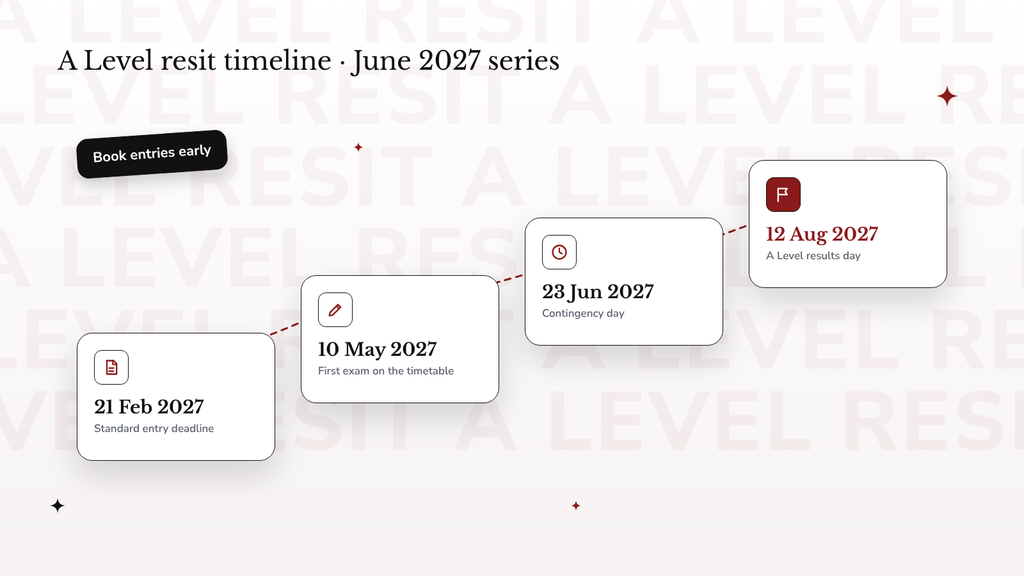
| Important event | Date |
| Standard examination entry deadline | 21 February 2027 |
| First examination on the common timetable | 10 May 2027 |
| Examination contingency day | 23 June 2027 |
| A-Level results day | 12 August 2027 |
These dates provide a general planning framework. Individual subjects have separate examination dates, and schools or colleges may set earlier internal registration deadlines. Students should check official A-Level resit dates through their awarding organisation, such as AQA, OCR, or Pearson Edexcel. International A-Level qualifications may follow different examination schedules, so candidates must confirm their specific qualification.
How to Register for an A-Level Resit
Students should begin by contacting their previous school or college to ask whether examination entries are available. The examinations officer can explain entry procedures, relevant fees, and deadlines. If the original institution cannot accept retake candidates, students may approach an approved private examination centre. It is important to confirm that the centre offers the correct subject and specification. Candidates should also check whether practical assessments, coursework, or other components require additional arrangements. Registering early allows more time to resolve potential issues before examinations.
A-Level Resit Cost and What Students Should Expect
The A-Level resit cost depends on several factors, including the examination board, subject, examination centre, and whether the student requires additional tuition. Students retaking examinations through their previous school or college may have different payment arrangements from private candidates. Some institutions may cover certain costs, while others charge examination or administration fees.
Private candidates preparing for an A-Level resit typically pay the examination centre, which includes awarding organisation charges and may add fees for administration, facilities, and invigilation. Subjects involving practical assessments can require additional arrangements. Students should request a complete fee breakdown before registering. This should clarify examination entry charges, administration costs, late-entry fees, and any additional assessment expenses.
Understanding Possible Expenses
Exam entry is only one possible cost. Students may also need textbooks, revision materials, online courses, private tuition, or travel to an examination centre. For example, a student preparing independently for Psychology may spend less on tuition than someone enrolling in a structured classroom programme. However, independent study requires effective organisation and consistent revision. Comparing available preparation options helps students balance affordability with educational support. The most suitable arrangement depends on individual learning needs, available resources, and examination requirements.
Resitting A-Levels for University and What You Need to Know
Resitting A-Levels for university can be a practical option when students narrowly miss their conditional offers or want to apply for courses with higher entry requirements. Many universities consider applications from students retaking qualifications. However, policies differ between institutions and courses. Some programmes accept resits without additional restrictions, while others apply specific conditions.
For students considering an A-Level resit, checking university admissions policies before registration is essential. This is particularly important for competitive programmes such as Medicine, Dentistry, and Veterinary Medicine, where resit requirements may be stricter. For example, Durham University states that A-Level retakes do not automatically disadvantage applicants. Other institutions may consider resits differently, demonstrating why course-specific guidance is important.
How to Declare Retakes on UCAS
Students applying through UCAS must accurately report their previous qualifications and results. If they are retaking a subject, they should include the original achieved qualification and add another entry showing the upcoming attempt as pending. Predicted grades may also be required for pending qualifications. These are normally provided by a teacher, tutor, or appropriate referee who can assess the student’s likely performance. Applicants should avoid leaving previous results out of their applications. Accurate academic information helps universities assess qualifications and make appropriate admissions decisions.
Should You Retake A-Levels or Consider Other Options?
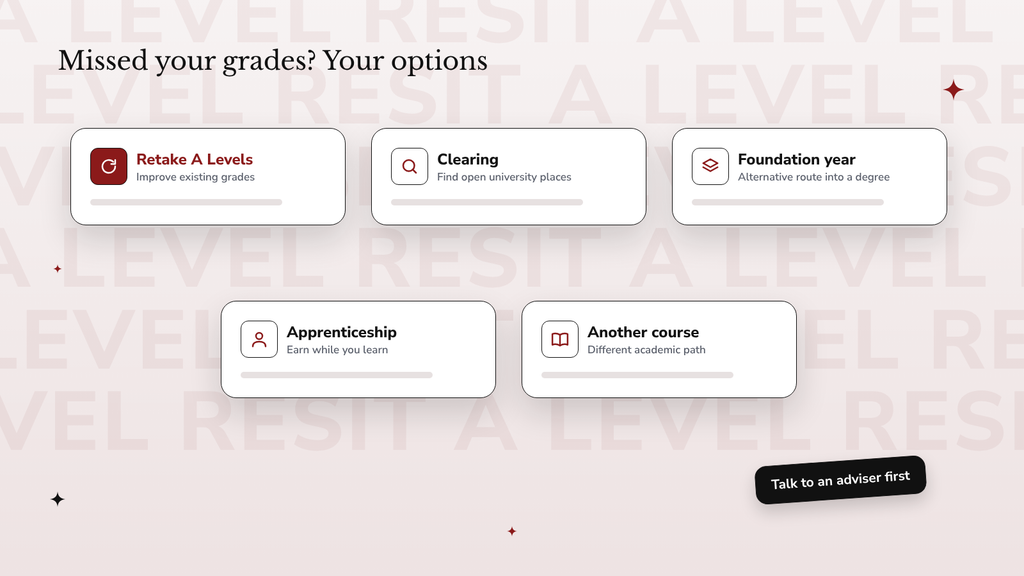
Retaking examinations is not always the only available pathway. Students who miss university entry requirements may also explore alternative courses, foundation years, apprenticeships, or other qualifications. The most appropriate decision depends on the grades achieved, the requirements of the intended course, and whether improved results are realistically achievable.
| Option | Main advantage | Important consideration |
| Retake A-Levels | Opportunity to improve existing grades | Requires additional preparation time |
| University Clearing | Explore available university places | Course availability varies |
| Foundation year | Alternative route into certain degrees | Additional study may be required |
| Apprenticeship | Combine employment with structured learning | Entry requirements differ |
| Alternative university course | Explore other academic pathways | Course content and outcomes may differ |
An A-Level resit may be worthwhile when improved grades could help students qualify for their preferred programme. However, learners should compare the available alternatives rather than assuming retaking examinations is always necessary. Speaking with teachers, career advisers, and university admissions teams can help students understand which option best supports their educational goals.
How to Improve Your A-Level Grades on Your Next Attempt
Improving examination results requires more than repeating previous revision methods. Students should identify weaknesses, understand assessment requirements, and build a structured preparation routine.
Create a Realistic Study Schedule
Begin by reviewing the relevant subject specification and identifying areas that need improvement. Divide larger topics into manageable sections and allocate revision time according to difficulty. For example, a Chemistry student may focus on organic reactions during one study session and quantitative chemistry during another. Regular topic-based practice can make complex material easier to understand. Students preparing for an A-Level resit should also include time for reviewing previously studied topics. Spaced revision can strengthen long-term understanding and reduce the need for intensive last-minute preparation.
Practise Examination Questions Regularly
Official past papers are valuable resources because they demonstrate question formats, assessment objectives, and expected answer structures. Students should begin with topic-specific questions before progressing to complete timed examinations. This approach allows them to build confidence while gradually improving examination technique. Reviewing mark schemes and examiner reports can help identify common mistakes. However, understanding why an answer earns marks is more important than memorising model responses without understanding the underlying concepts.
Get Feedback and Monitor Progress
Teachers and tutors can provide useful guidance when students struggle with difficult concepts. Regular feedback helps identify weaknesses that may not be obvious during independent revision. Students should maintain a record of completed topics, practice results, and recurring errors. Reviewing this information can help them adjust their study plans and concentrate on areas requiring additional attention.
Common Mistakes Students Should Avoid
One common mistake is focusing entirely on reading textbooks without completing examination questions. A-Level assessments often require applying knowledge, analysing information, and developing reasoned arguments. Another mistake is using revision resources that do not match the correct examination specification. Although subjects may overlap between awarding organisations, content and assessment structures can differ. Students planning an A-Level resit should also avoid leaving revision until the final months. A consistent study routine with realistic goals, regular practice, and sufficient rest is generally more sustainable than last-minute preparation.
Conclusion
Retaking A-Level examinations can provide students with an opportunity to improve their academic qualifications and pursue educational goals that may not have been achievable with their original results. An A-Level resit requires careful planning, including understanding examination dates, registration requirements, potential costs, and university admissions policies. Students should also consider whether alternative educational pathways could meet their needs. With structured revision, appropriate support, and regular examination practice, learners can address previous weaknesses and approach their next assessments with greater confidence.
Frequently Asked Questions
1. What is an A-Level resit, and who can take one?
An A-Level resit allows students to retake a qualification to improve their previous result. Students who have already completed A-Levels can generally register through schools, colleges, or approved examination centres, subject to the relevant entry requirements.
2. Can you resit A-Levels more than once?
Yes. There is generally no fixed overall limit on the number of times students can retake eligible qualifications. However, each attempt requires registration, and universities may have specific policies regarding multiple attempts.
3. When are A-Level retake examinations held?
In England, standard A-Level examinations are normally held during the summer examination series. Students should consult the official awarding organisation timetable for exact subject dates.
4. Will universities accept students who retake A-Levels?
Many universities accept retake applicants, but policies vary. Some competitive courses may impose additional conditions, so students should confirm the requirements of their chosen university and degree programme.
5. Do students need to retake every examination paper?
For linear A-Levels in England, students generally need to complete all required written examination components again. Certain non-examination assessments may be eligible for carry-forward arrangements, depending on the subject and awarding organisation.
6. Can students prepare independently for A-Level examinations?
Yes. Students can study independently and register through an approved examination centre. However, subjects involving practical assessments or coursework may require additional arrangements, and candidates should confirm these before registration.