
Receiving GCSE results can be an important moment for students, but not everyone achieves their expected grades. Some may need higher marks to qualify for college, apprenticeships, or future career opportunities. Fortunately, disappointing results do not mean educational progress must stop. Retaking an examination allows students to improve their grades, strengthen their understanding, and develop better examination techniques.
A GCSE resit gives students another opportunity to achieve their desired grades. English Language and Mathematics have additional examination opportunities in November, while most other subjects are normally assessed during the summer. Understanding exam dates, registration requirements, and preparation strategies can help students approach their next attempt confidently. Reviewing previous results, identifying weak areas, and practising past papers are essential steps towards improvement.
What Is a GCSE Resit and How Does It Work?
A GCSE resit is an opportunity to retake a General Certificate of Secondary Education qualification after receiving an earlier result. Students commonly choose this option when they have not achieved the grade required for further education, employment, or a particular training programme. The process typically involves registering through a school, college, or approved examination centre. Students prepare for the relevant assessments and sit the required examinations during an available examination series. Depending on the subject, additional assessment requirements may also apply.
For example, a student who achieved grade 3 in Mathematics may take a GCSE resit to work towards grade 4. This can help meet the entry requirements of many educational programmes. However, students should always check the specific grades required by their chosen institution. Most written GCSE examinations must be retaken as part of the relevant qualification rather than repeating only an individual paper. Rules about carrying forward non-examination assessments can differ between subjects and awarding organisations.
Who Needs to Retake GCSE Examinations?
Not every student with an unsatisfactory result is required to retake an examination. The need to continue studying depends on previous grades, age, educational programme, and qualification requirements. In England, students aged 16 to 18 on eligible funded study programmes who have not achieved grade 4 or an accepted equivalent in English or Mathematics generally need to continue studying the relevant subject.
Under the 2026–2027 funding guidance, full-time students with grade 3 must normally study towards a GCSE in that subject. Students with grade 2 or below may study towards an approved alternative, such as Functional Skills, where appropriate. However, a GCSE resit may still be the preferred route when a particular qualification or grade is required. Students who already hold a passing grade may also choose to improve their results. For example, someone with grade 4 in Mathematics might need grade 6 for a particular sixth-form course.
GCSE Resit Dates and When You Can Retake Exams
Understanding examination schedules is essential when planning revision and registration. In England, GCSE examinations primarily take place during the summer, with an additional November series available for English Language and Mathematics.
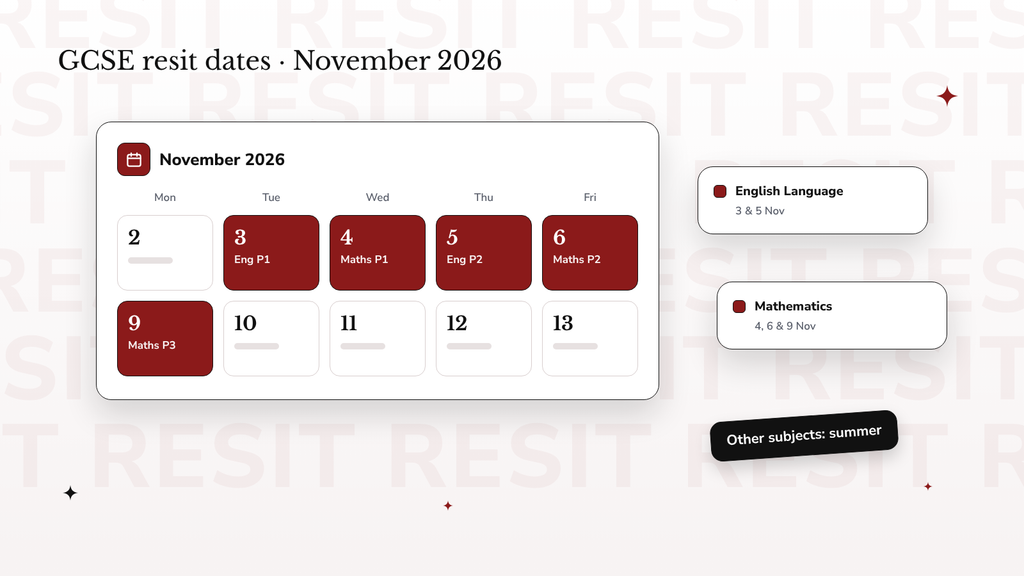
For November 2026, the published examination timetables list the following dates for the relevant GCSE papers.
| Subject | November 2026 examination dates |
| English Language Paper 1 | 3 November |
| English Language Paper 2 | 5 November |
| Mathematics Paper 1 | 4 November |
| Mathematics Paper 2 | 6 November |
| Mathematics Paper 3 | 9 November |
Students preparing for a GCSE resit should confirm their examination dates with their awarding organisation and centre. The next summer examination series provides opportunities for other GCSE subjects, while registration deadlines vary between centres.
How to Register for a GCSE Resit
Students currently attending school or college should contact their subject teacher or examinations officer. These staff members can explain whether the institution offers retake examinations and what preparation support is available.
Private candidates can contact approved examination centres that accept external entries. Before registering, they should confirm the qualification specification, examination fees, assessment requirements, and entry deadlines. Early registration is helpful because some centres have internal deadlines before the awarding organisation’s final entry date. Students should also check whether additional coursework or practical arrangements are required.
GCSE Maths Resit Guide on How to Improve Your Grade
A GCSE maths resit provides an opportunity to strengthen mathematical understanding and improve examination performance. Mathematics is widely required for further education, apprenticeships, and many employment opportunities. Students should begin by reviewing their previous performance and identifying challenging topics. Common areas include fractions, percentages, algebra, geometry, probability, and statistics.
Understanding which topics caused difficulties allows revision time to be allocated more effectively. For example, a student struggling with algebra can begin by reviewing simple equations before attempting more complex questions. Preparing for a GCSE resit becomes more manageable when learners focus on specific weaknesses rather than repeating every topic without a clear plan.
Practical Mathematics Revision Techniques
Students should practise mathematical methods regularly and gradually increase the difficulty of questions. Reviewing worked examples can help develop understanding, but independent problem-solving is essential for examination preparation. Timed examination papers also provide useful practice. Students can identify whether they struggle with calculations, interpreting questions, or completing assessments within the available time.
Choosing the correct examination tier is another important consideration. Foundation and Higher tiers have different grade ranges, so students should discuss the appropriate option with their teacher or examination centre.
GCSE English Resit Guide to Improving Reading and Writing Skills
A GCSE English resit generally focuses on English Language, particularly for students seeking to meet further education requirements. The qualification assesses reading comprehension, language analysis, evaluation, and written communication. Students should begin by understanding the assessment objectives of their examination board. These explain the skills required in different questions and help learners recognise how marks are awarded.
For example, students preparing for a GCSE resit in English Language can practise analysing short passages, identifying writers’ techniques, and explaining how language influences readers. Regular writing exercises can also improve clarity, organisation, grammar, and vocabulary.
How to Strengthen English Examination Skills
Reading a variety of texts can help students become more comfortable identifying ideas, arguments, and language techniques. Practising questions from official examination papers provides additional preparation. For writing tasks, students should focus on planning responses, organising paragraphs, and using appropriate language for different audiences. Proofreading is equally important for identifying spelling, punctuation, and grammatical errors. Feedback from teachers or tutors can help learners recognise recurring mistakes. Students should review this feedback and apply it during subsequent practice sessions.
Can You Resit GCSEs After Leaving School?
Many learners ask, can you resit GCSEs after completing secondary education? Yes, students and adults can retake GCSE qualifications after leaving school, provided they register through an appropriate examination centre. Colleges, adult education providers, and independent examination centres may offer suitable opportunities. However, available subjects, teaching arrangements, and examination fees vary between providers.
For adults considering a GCSE resit, the first step is to confirm the qualification needed for their intended course or career. Some institutions accept alternatives, while others specifically require GCSE English or Mathematics at particular grades. 00For example, someone applying for a professional training programme may need to demonstrate English and Mathematics qualifications. Checking the entry requirements before registering can prevent unnecessary costs and delays.
Key Differences Between GCSE Resits and Functional Skills
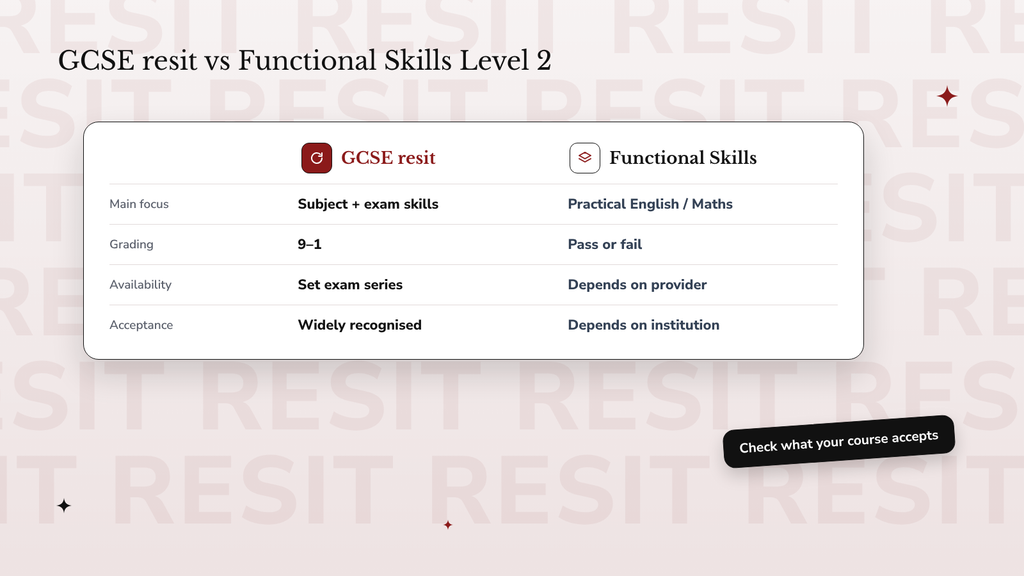
Students who need to improve English or Mathematics may encounter both GCSE qualifications and Functional Skills courses. Although these options can support academic or career progression, they have different assessment methods and recognition requirements. GCSEs follow subject specifications that assess knowledge and academic skills. Functional Skills qualifications focus more directly on using English and Mathematics in practical situations.
| Feature | GCSE Retake | Functional Skills Level 2 |
| Main focus | Subject knowledge and examination skills | Practical English or Mathematics |
| Grading | 9–1 | Pass or fail |
| Assessment | GCSE examination requirements | Qualification-specific assessments |
| Availability | Scheduled examination series | Depends on provider |
| Acceptance | Widely recognised | Depends on institution |
A GCSE resit may be more suitable when a college, university, or employer specifically requires a GCSE qualification. Students should always verify whether alternative qualifications satisfy their intended entry requirements.
How to Pass Your GCSE Exams on the Next Attempt
Improving examination results requires a structured revision approach. Rather than relying on last-minute studying, students should identify weaknesses, set manageable goals, and monitor their progress.
Create a Realistic Study Schedule
Start by reviewing the official specification and dividing the required content into smaller topics. Allocate more revision time to challenging areas while continuing to practise familiar material. A useful study routine might include topic revision, practice questions, and a short review of mistakes. Regular sessions can make preparation more manageable than attempting to cover large amounts of information immediately before examinations.
Practise Past Papers and Review Mistakes
Past examination papers help learners understand question formats, assessment expectations, and time limits. Students should prioritise materials from their own awarding organisation. When preparing for a GCSE resit, reviewing mistakes is just as important as completing questions. Identifying why an answer was incorrect helps students understand whether they need to improve subject knowledge, examination technique, or time management.
Ask for Feedback and Track Progress
Teachers, tutors, and appropriate educational resources can help explain difficult concepts. Students should seek clarification when they repeatedly struggle with similar questions. Keeping a record of completed topics and common errors can also support better revision decisions. This allows students to focus on areas where additional practice is most needed.
Common Mistakes Students Should Avoid
One common mistake is relying entirely on reading textbooks without practising examination questions. Although reading can support understanding, students must also develop the ability to apply knowledge independently. Structures may differ, making board-specific revision materials important. Students preparing for a GCSE resit should also avoid unrealistic revision schedules. Consistent practice, sufficient rest, and regular feedback provide a more sustainable approach than intensive last-minute studying.
Conclusion
Retaking GCSE examinations can provide students with another opportunity to improve their qualifications and progress towards educational or career goals. Understanding the examination process, available dates, and registration requirements is an important first step. A successful GCSE resit requires careful preparation, appropriate revision resources, and a willingness to address previous weaknesses. Students should focus on improving understanding rather than simply memorising answers. Whether retaking English, Mathematics, or another subject, a structured study plan and consistent examination practice can help learners approach their next assessment with greater confidence.
Frequently Asked Questions
1. What is a GCSE resit, and who can take one?
A GCSE resit allows students to retake a qualification to improve their previous grade. School students, college learners, and adults can register for eligible examinations through approved centres, subject to the applicable entry requirements.
2. Can students retake GCSE examinations more than once?
Yes. There is generally no fixed limit on the number of attempts. However, candidates must register for each examination series and follow the awarding organisation’s requirements.
3. When are GCSE retake examinations held?
English Language and Mathematics examinations are available in November and during the summer examination series in England. Most other GCSE subjects are normally assessed during summer.
4. Do students have to pay for GCSE retakes?
Fees depend on individual circumstances. Eligible learners studying through funded programmes may receive examination support, while private candidates generally pay examination and centre fees.
5. Can students retake English and Mathematics together?
Yes. Students can prepare for both qualifications during the same examination series, provided they meet the relevant eligibility and registration requirements.
6. Is it possible to improve a GCSE grade from 3 to 4?
Yes. Students who previously achieved grade 3 can work towards grade 4 through further study and examination preparation. Their result will depend on their performance and the qualification’s assessment requirements.