
Choosing the right educational pathway after secondary school is an important decision for students and parents. With several qualifications available, understanding their structure, assessment methods, and university recognition can help families make informed choices. International qualifications are particularly relevant for students considering higher education in different countries.
The Cambridge International AS and A Level programme offers advanced academic qualifications designed to prepare students for university and further study. It provides opportunities to develop subject knowledge, analytical thinking, problem-solving abilities, and independent learning skills. Students can explore subjects according to their interests and future educational goals.
For parents, understanding the differences between AS and A Level qualifications is essential. Questions about examination formats, grading systems, subject combinations, and university acceptance often arise before enrolment. This guide explains how the programme works, what students should expect, and how families can support successful academic preparation.
What Is Cambridge International AS and A Level?
Cambridge International AS and A Level is an advanced academic qualification offered by Cambridge International Education. It is generally intended for students aged 16 to 19 and provides a pathway from secondary education to universities and other higher education institutions.
The programme allows students to develop detailed knowledge in selected subjects rather than studying a broad compulsory curriculum. Learners can specialise in sciences, mathematics, humanities, languages, or other areas according to their academic interests and future ambitions.
Typically, an AS Level takes one year, while a full A Level takes approximately two years. The Cambridge International AS and A Level framework provides different assessment routes, allowing eligible students to complete an AS qualification independently or progress towards the full A Level.
Cambridge qualifications are used by schools internationally and are recognised by universities in many countries. However, students should always check the specific subject and grade requirements of institutions they plan to apply to.
AS Level vs A Level and Understanding the Differences
One of the most common questions parents ask concerns AS Level vs A Level. Although both qualifications belong to the same educational pathway, they differ in study duration, syllabus content, and qualification level. An AS Level generally covers approximately half the content of the corresponding full A Level. It usually takes one academic year and can be completed as a standalone qualification in subjects where that option is available.
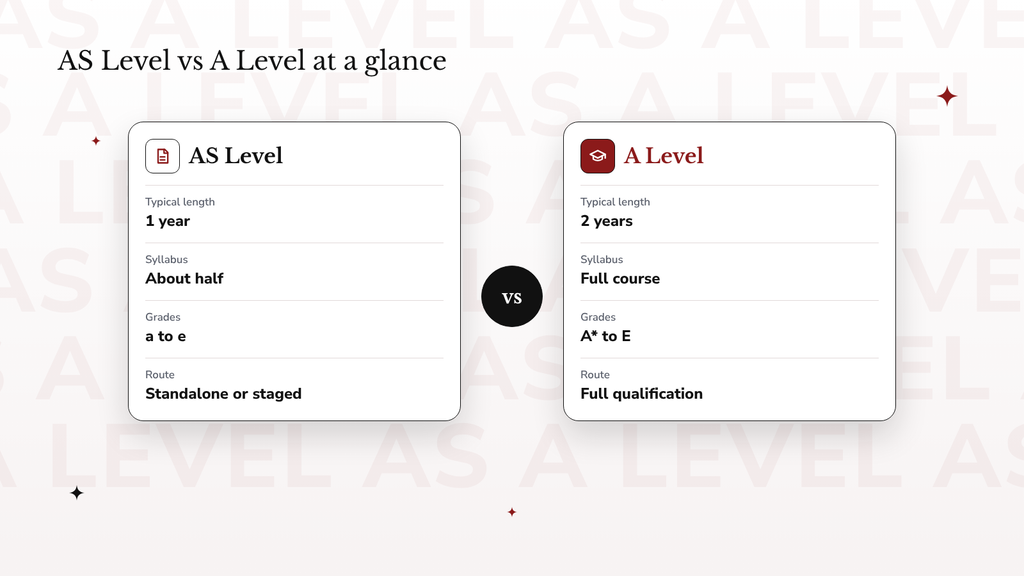
A full A Level involves more extensive study, typically over two academic years. Students develop deeper subject knowledge and complete additional assessments designed to evaluate their understanding, analytical skills, and application of concepts.
| Feature | AS Level | A Level |
| Typical duration | One year | Two years |
| Syllabus coverage | Approximately half of A Level | Full syllabus |
| Grades | a to e | A* to E |
| Qualification | Standalone or part of a staged route | Complete advanced qualification |
| University recognition | Accepted where entry requirements permit | Widely accepted for university entry |
For example, a student studying Mathematics may complete the AS components in the first year before continuing to the remaining A Level content. This approach can help parents monitor progress while students develop the skills needed for more advanced study.
Cambridge International AS and A Level Assessment Options
The programme offers different assessment arrangements, allowing schools and students to plan examinations according to qualification requirements. Understanding these options helps families prepare for examination registration and academic progression.
Assessment Routes in Cambridge International AS and A Level
Students generally have three main assessment options, depending on their chosen subject and syllabus requirements. The first option is to complete the AS Level as a standalone qualification. The second is staged assessment, where students complete their AS examinations before taking the remaining A Level components in a later examination series.
The third option allows students to complete all required A Level examination papers in a single examination series, usually at the end of their studies. For eligible subjects, AS results can contribute towards the final A Level within a permitted 13-month period. However, staged assessment is not available for every syllabus. Parents should confirm the applicable entry rules with their school or examination centre before planning this route.
Understanding Cambridge A Level Grading
The Cambridge A Level grading system measures student achievement against qualification standards. Understanding how grades are awarded can help parents interpret examination results and identify realistic academic targets. For full A Levels, grades range from A* to E, with A* representing the highest achievement. AS Level grades range from A to E, with no A* grade available at this level.
Performance below the minimum required standard is reported as ungraded. Students studying Cambridge International AS and A Level subjects receive separate results for each qualification. A strong result in one subject does not automatically determine performance in another, since each syllabus has its own assessment requirements.
How Are Final Grades Determined?
Final grades are based on performance in the relevant assessment components and the grade thresholds established for the examination series. These thresholds may vary between sessions depending on examination difficulty. For example, a student who performs well in written examinations but struggles with another required component may receive a lower overall grade than expected.
Understanding component weightings can therefore help students allocate revision time effectively. Parents should avoid comparing raw examination marks without considering the syllabus, assessment structure, and grade thresholds. Official grade threshold documents provide more reliable information when reviewing results.
Are Cambridge International Qualifications Recognised by Universities?
University recognition is an important consideration for families planning higher education. Cambridge International qualifications are accepted by universities across many countries, including the United Kingdom and numerous institutions in North America, Europe, Asia, and other regions. Students completing Cambridge International AS and A Level programmes can apply to universities according to each institution’s admissions policies. Some universities accept particular AS qualifications, while others require full A Levels and specific grades.
For example, an applicant interested in engineering may need particular Mathematics and Physics qualifications. Another student applying for a humanities degree may face different subject requirements. Parents should check official university websites for entry criteria, English-language requirements, admissions tests, and application deadlines. Recognition of a qualification does not automatically guarantee admission to a particular course.
How Parents Can Support Their Child’s Academic Progress
Parental involvement can make a meaningful difference when students manage challenging academic workloads. However, effective support focuses on providing structure, encouragement, and access to suitable learning resources rather than placing unnecessary pressure on results. Families can begin by creating realistic study routines that include regular revision, breaks, and adequate time for rest.
Parents should also encourage students to discuss difficult topics with teachers before misunderstandings become persistent learning problems. For Cambridge International AS and A Level students, using official syllabus documents and past examination papers can strengthen preparation. These resources explain the required knowledge and help learners become familiar with examination question formats.
Encourage Independent Learning
Advanced qualifications require students to take greater responsibility for their studies. Parents can encourage this development by allowing learners to organise revision schedules, track progress, and identify topics requiring additional attention. For example, a student struggling with Economics could review a topic, explain its main concepts without notes, and complete related examination questions.
Comparing answers with official mark schemes can help identify areas for improvement. Regular conversations about progress are often more useful than focusing entirely on predicted grades. Supporting independent learning helps students develop habits that can remain valuable throughout university education.
Common Challenges Students May Face
Students often experience difficulties when moving from secondary-level qualifications to more advanced academic study. Subjects require greater depth of understanding, stronger analytical skills, and the ability to apply knowledge in unfamiliar situations. Time management can also become challenging when several subjects have demanding examination requirements.
Students following Cambridge International AS and A Level courses should divide larger topics into manageable study sessions and avoid leaving revision until examination season. Another common challenge is relying too heavily on memorisation. Many examinations require explanations, calculations, evidence-based reasoning, and evaluation. Practising these skills regularly helps students understand how knowledge should be applied in different contexts.
Cambridge A Level Subjects and How to Choose the Right Combination
Choosing suitable Cambridge A Level subjects is an important step in preparing for future university applications. The programme offers a wide selection of academic subjects, allowing learners to specialise in areas that match their interests and educational ambitions. Popular subject options include Mathematics, Physics, Chemistry, Biology, Economics, Business, Computer Science, English Literature, History, and Geography.
Availability depends on the school, and certain syllabuses may have different AS and A Level options. Students following Cambridge International AS and A Level qualifications should consider their academic strengths alongside future course requirements. Selecting subjects only because friends have chosen them may create difficulties if those subjects do not match a student’s abilities or intended degree programme.
Choosing Subjects Based on Career Goals
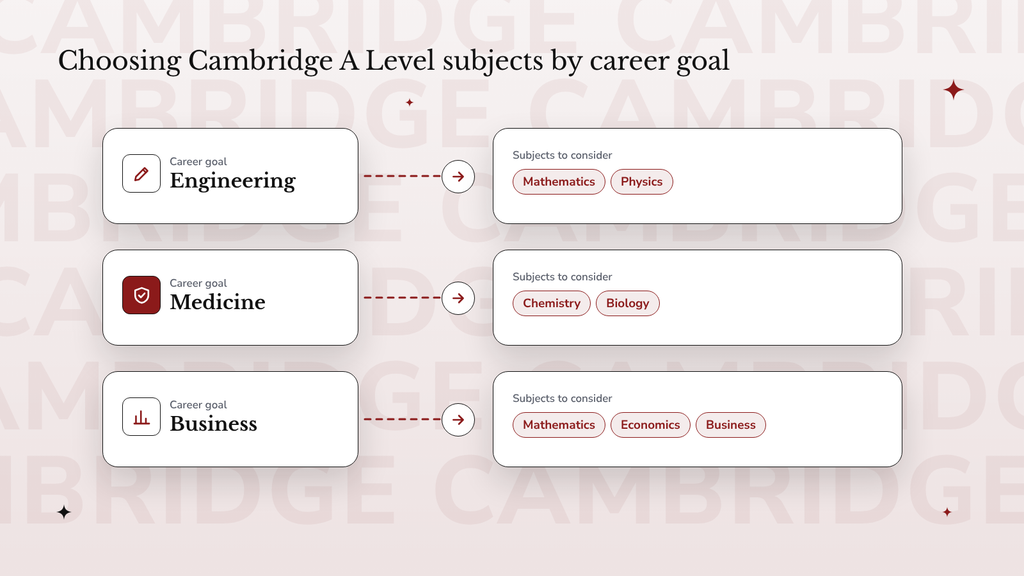
For example, a student interested in engineering may consider Mathematics and Physics, while someone planning to study medicine might prioritise Chemistry and Biology alongside other subjects required by their target universities. Students interested in business-related degrees may explore Mathematics, Economics, and Business.
However, universities can have specific requirements, and some programmes prefer or require particular combinations. Parents should review university admissions criteria before finalising subject choices. They should also speak with teachers about workload, previous academic performance, and the level of independent study each subject requires.
Practical Tips for Effective Examination Preparation
Successful preparation begins with understanding the relevant syllabus. Students should identify the topics they need to study, review assessment objectives, and develop a revision plan that covers all required content before examinations. Official past papers can be particularly useful for building familiarity with examination formats. However, students should also review mark schemes, correct mistakes, and practise explaining concepts in their own words.
Parents supporting Cambridge International AS and A Level preparation should encourage consistent practice rather than last-minute studying. Combining topic revision, timed assessments, and constructive feedback can help learners identify weaknesses and build confidence. Students should also confirm that revision materials match the correct syllabus year. Cambridge updates certain syllabuses periodically, so using outdated textbooks or examination guidance without checking the current specification may confuse.
Common Mistakes Parents Should Avoid
One mistake is selecting subjects without checking university requirements. Some degree programmes require specific qualifications, and changing subjects later may limit available study options. Another mistake is assuming every subject follows identical assessment arrangements. Examination components, coursework requirements, and practical assessments vary, making it important to review individual syllabuses. Parents should also avoid comparing their child’s progress directly with other students. Academic strengths, learning speeds, and subject combinations differ. A more useful approach is to monitor individual improvement and provide support where necessary.
Conclusion
Understanding international advanced qualifications helps parents guide their children through important educational decisions. Subject selection, assessment arrangements, grading, and university entry requirements all deserve careful consideration before students begin their courses. Cambridge International AS and A Level provides opportunities for students to develop specialised academic knowledge, independent thinking, and examination skills. Its different assessment routes can support varied educational plans, provided students follow the requirements of their chosen subjects. By reviewing official syllabuses, checking university expectations, and encouraging consistent preparation, parents can help their children approach advanced studies with clearer goals and greater confidence.
Frequently Asked Questions
1. What is Cambridge International AS and A Level?
Cambridge International AS and A Level is an advanced academic qualification pathway designed for students preparing for university and further education. AS Level usually takes one year, while a full A Level typically takes two years, depending on the study route.
2. Can students complete AS Level without continuing to A Level?
Yes. AS Level can be completed as a standalone qualification where the syllabus permits. Students may also continue towards the full A Level through eligible assessment routes.
3. How many subjects should students choose?
The appropriate number depends on school requirements, workload, academic strengths, and university entry criteria. Parents should consult teachers and intended universities before deciding.
4. Are Cambridge International A Levels accepted in the UK?
Yes. UK universities recognise Cambridge International A Levels for admission. However, individual courses may require specific subjects, grades, or additional assessments.
5. Can students retake Cambridge examinations?
Retakes are possible, subject to examination availability, entry rules, and the relevant syllabus. Students should confirm the applicable arrangements with their examination centre, particularly if they intend to carry forward previous results.
6. How can parents find the correct Cambridge syllabus?
Parents can visit the official Cambridge International website and search for their child’s subject and syllabus code. They should select the syllabus version corresponding to the examination year and confirm details with the school.